LOOKING UP

THE 40-PAGE MONTHLY INTERNATIONAL

AUTISM NEWSLETTER


Editor: Adam Feinstein, email editor@lookingupautism.org

Web page maintained by Joel Feinstein


LOOKING UP is a monthly 40-page international newsletter devoted to autism. Aimed at parents and professionals alike, it is a lively and informative mix of the very latest findings in autism research from around the world and articles which explore the impact of autism in all areas.

We have access to the most up-to-date material in more than a dozen languages concerning possible causes and treatments of autism, together with the latest educational approaches. We publish articles relating to autism in the family, school and further education, employment, film and the other arts, politics, sport and society.


LOOKING UP is edited by Adam Feinstein, who has a son with autism (see Adam's home page) Adam can be contacted by e-mail at Adam@lookingupautism.org
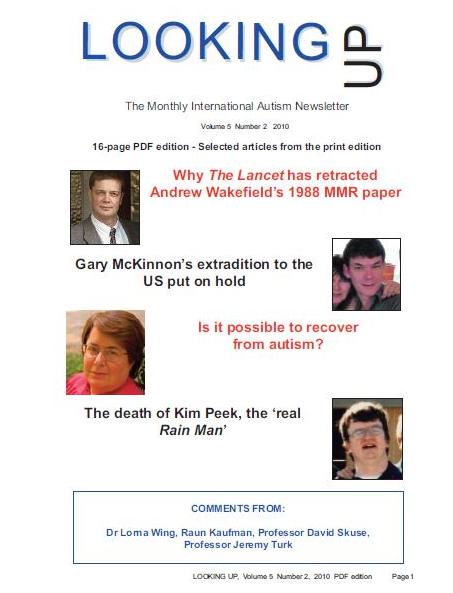
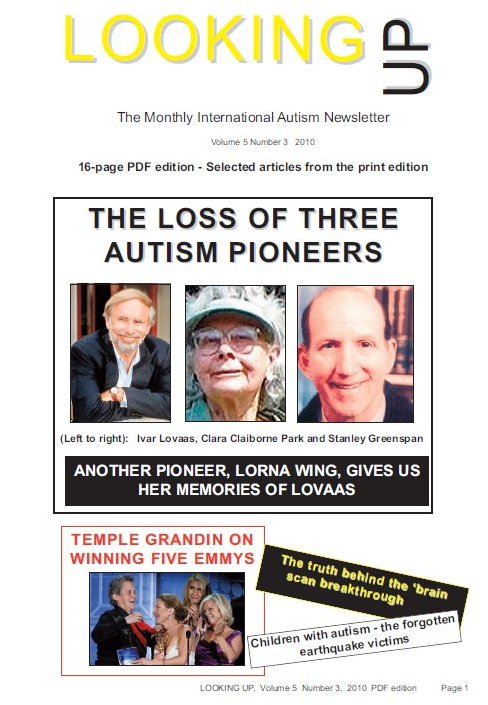
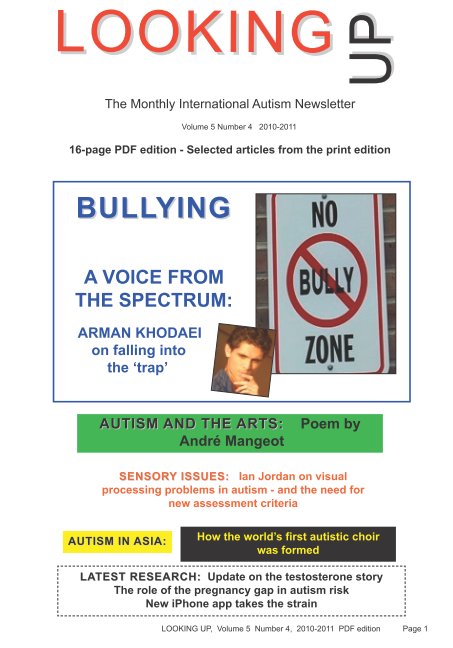
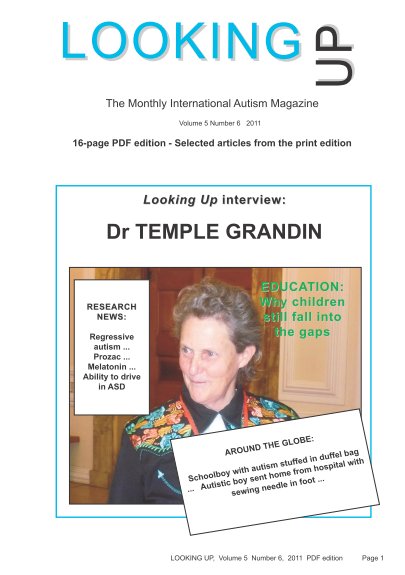
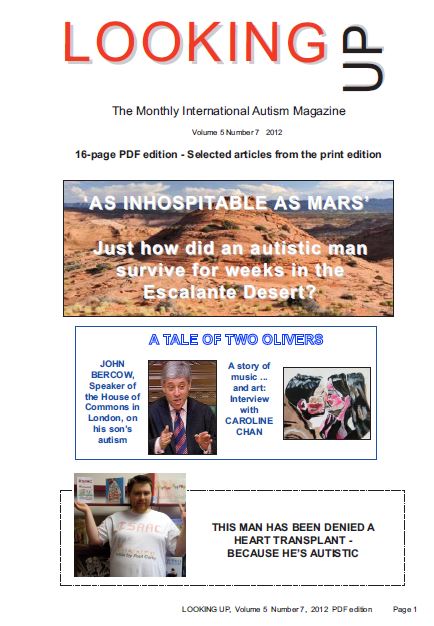
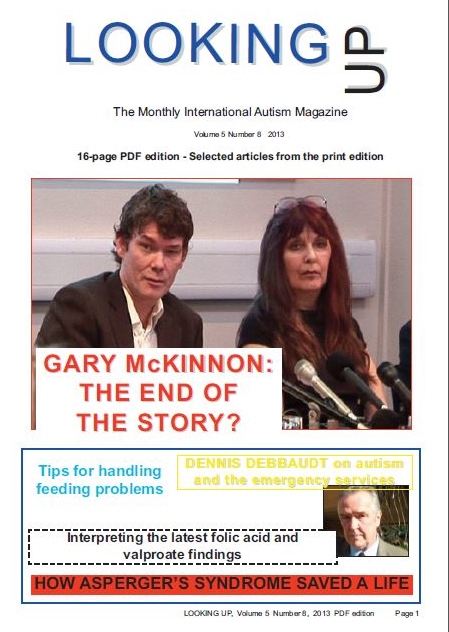
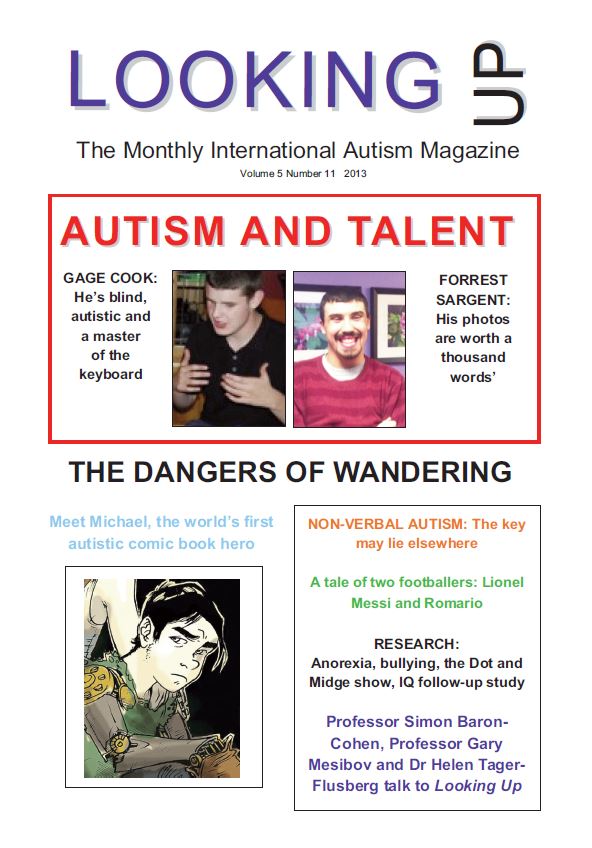
Here is the front cover of the latest issue. Click on the cover for information about all Looking Up back issues.

We have a page of book recommendations by the editor. We also have a Google group for announcements and discussion related to Looking Up, and other autism-related discussion. Please feel free to visit our newsgroup and contribute.

WHAT SUBSCRIBERS SAY ABOUT LOOKING UP:

If are interested in subscribing, or wish to order back issues, follow this link to our subscription page.

Our address is: Looking Up, PO Box 25727, London, SW19 1WF, England.

For general enquiries, our e-mail address is info@lookingupautism.org

TEL: (London, England) (0)20-8542 7702

FAX: (England) (0)870-0521548


Adam Feinstein's Home Page


Here are the first few paragraphs of one of the selected articles currently available online.

Interview with Dr Tony Attwood

From Volume 3 Number 6

Dr TONY ATTWOOD, a clinical psychologist based in Queensland, Australia, is widely ackowledged to be the world’s leading expert on Asperger’s syndrome  Adam Feinstein spoke to him in Melbourne

ADAM FEINSTEIN:  Asperger’s syndrome has been recognised only relatively recently as a specific disorder. What do you think have been the major advances in our understanding of the condition over the past 30 years since Hans Asperger’s 1944 paper was translated into English?

TONY ATTWOOD: I think the main advances have come not from the research literature but from conversations and discussions with those who have Asperger’s syndrome, by reading not the scientific textbooks but their autobiographies. My greatest knowledge of Asperger’s has come from those who have it. Other great advances are the recognition of the challenges they face, and some way of helping them to cope. What may also be occurring is a change in attitude towards these attitudes and, I hope, a greater emphasis on their talents rather than their deficits.

ADAM FEINSTEIN  It used to be thought that individuals with Asperger’s syndrome had a normal command of language and that this, indeed, was one of the characteristics which distinguished Asperger’s from autism. We now know that the language used by people with Asperger’s is often stilted, not normal. I have spoken to Lorna Wing in the UK about the use of language in autistic children who, like my son, lost their speech, and I agree with Lorna that the nature of that language was non-social. My question is this: is the language used by people with Asperger’s resolutely asocial?  Is their obsession with talking about dinosaurs or lightbulbs or Winston Churchill a deliberate attempt to avoid meaningful social interaction?

TONY ATTWOOD:  You’ve asked many questions there. I’ll answer them one by one. The language profile in Asperger’s syndrome is different. Whether or not they were delayed in language when they were young children is, I believe, irrelevant. What is important is how they use language in a social context.  The art of conversation is not something in which they are naturally skilled. Also, they are not skilled in translating their thoughts into speech. And quite often, their thoughts may be visualisations or concepts which are not easy to convey in spoken communication but which may be conveyed by written or typed communication in e-mails, drawings, etc. But in a social setting, there are problems in the pragmatic aspects of language - especially social conversation. There can also be difficulties with regard to being somewhat pedantic, with rather odd prosody, and with not picking up the cues. But certainly, when I, as a clinician, socialise linguistically with someone with Asperger’s syndrome, it tends, from their point of view, to be somewhat artificial, contrived, laborious and clumsy. Yet, when you start talking about their special interests, then their eloquence, fluency and enthusiasm can be most captivating. So with speech, it depends on what you’re talking about.

ADAM FEINSTEIN:  In the case of those children who lost their language, some do begin to speak again. I have not seen this question asked before, so here goes. Do any of these individuals ever regain a sufficient level of language to warrant a diagnosis of Asperger’s syndrome? Has this ever happened?

TONY ATTWOOD:  At  present, we have not thoroughly examined the longitudinal development of those who have late-onset autism:  those who, as far as we can tell, have relatively normal development and then lose not only linguistic skills but social and play skills. Some of these children can - perhaps two, three or four years later - recover some of their speech and go beyond the level they had  reached before it started to disappear. We do not really know whether these groups have a distinct prognosis, but I do know that some who lose their speech may achieve speech later on and move into the description of Asperger’s syndrome rather than Leo Kanner’s classic autism.

Read the rest of this article

Search this site

Google Groups Beta
Looking Up
Visit this group

BACK ISSUE CONTENTS AND FRONT COVERS
VOLUME 1, Number: 1 2 3 4 5 6 7 8 9 10 11 12   VOLUME 2, Number: 1 2 3 4 5 6 7 8 9 10 11 12
VOLUME 3, Number: 1 2 3 4 5 6 7 8 9 10 11 12   VOLUME 4, Number: 1 2 3 4 5 6 7 8 9